215: Gavin Lorenzo: "Can AI Actually Understand Humans Without Human-Grade Self-Awareness?"
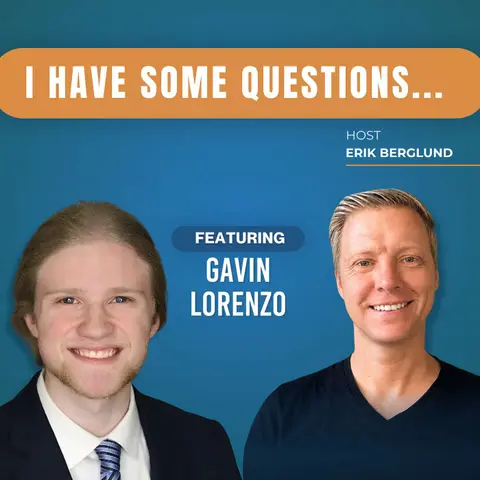


Gavin Lorenzo explains why AI struggles to truly understand people, not just store facts. He shares how Tellbloom builds a “third-party”-like model of a user by learning from passive interactions, then uses that context to improve responses. The conversation also covers testing, privacy, and the governance challenges raised by frontier models like Fable.
👤 About the Guest
Gavin Lorenzo is the founder of Tellbloom, working from Georgia with support from the Alabama Entrepreneurship Institute. A second-time founder, he built his way from an AI tutor for LSAT prep to a mission focused on helping AI understand humans. His current work includes a Chrome extension that analyzes how you interact with Claude or ChatGPT to personalize prompts more effectively.
🧭 Conversation Highlights
- Tellbloom’s goal: maximize AI’s understanding of humanity, moving beyond “memory” into predictive behavior and intuition-like grasp.
- Gavin’s origin story: building an LSAT tutor revealed AI’s limits in personalization and context formation.
- How Tellbloom tests progress: A/B testing many “pipelines,” persona-based fine-tuning, and benchmarking before wide deployment.
- Governance and safety: why model access, export controls, and safeguards matter, and why governance cannot be left solely to model companies.
💡 Key Takeaways
- Personalization fails when it depends too heavily on a user’s ability to articulate themselves; passive observation is a better data source.
- “Understanding” is hard to define, but Gavin frames it as the ability to accurately predict and adapt in a way that feels human.
- To make squishy human modeling testable, you need repeatable suites, personas, and benchmarks.
- As models get more powerful, regulation and privacy become central product and societal design problems, not afterthoughts.
❓ Questions That Mattered
- What does it mean for AI to “understand” a person, beyond recalling facts or recursing into retrieved memory?
- Where is the line between building a cool tool for yourself and solving a real, horizontal customer problem?
- How do you make psychology-like ideas falsifiable by testing them through an AI “template of intelligence”?
- If frontier models can be used for harm or circumvent safeguards, what governance framework should govern capability, access, and rollout?
🗣️ Notable Quotes
- “It’s really not possible to build those [models] programmatically without randomness and variance.”
- “You cannot alter what the circus is doing unless you are inside the circus.”
- “AI is going to have to understand [people] and intuit that understanding, or else it becomes a generalizing agent.”
🔗 Links & Resources
- Follow Gavin Lorenzo's LinkedIn
- Contact Gavin at gavinlorenzo11@gmail.com


